|
|
||||||||
|
123 Flash Menu Placeholder.
|
||||||||
|
"It is a Borneo experience that you can have only in this part of the world and while some aspects and elements may not be traditional, I would argue that they are authentic! "
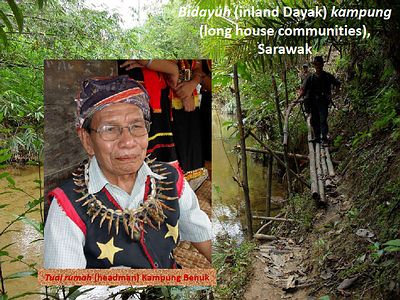
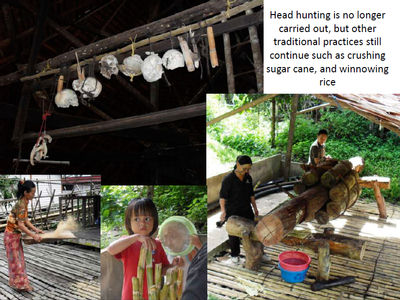
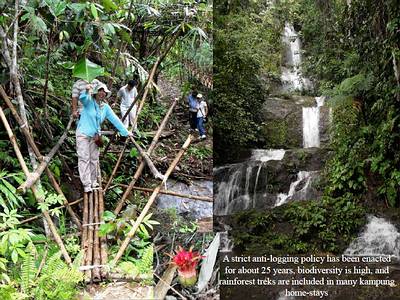
Most of the kampongs of the Bidayuh (inland Dayak communities as distinct from the Iban coastal or sea Dayaks) away from the towns are in heavily forested locations - the government banned logging almost 25 years ago so re-growth in the hot and humid tropical environment has been rapid. Hunting is also banned (although a little still takes place on the side). But the biodiversity is now quite rich, especially since the bamboo blowpipes previously used for bird hunting are also now banned, so avifauna have apparently recovered well. The kampungs we have visited are an interesting mix of old and new - plastic buckets alongside traditional hand-woven rattan baskets, split bamboo walkways and hand-woven mats covering the split bamboo flooring along the ruai (verandahs), with tin roofs replacing the sago palm thatch (corrugated iron is much preferred - lasts 20 years whereas the thatch has to be replaced every 2-3 years). Where there is electricity, satellite dishes for tv stick out along the longhouse roof and refrigerators can be seen in many of the bilik (separate apartments in the longhouse). Every household has its stone fireplace however, rather than gas or electricity, because they prefer to cook with wood, using bamboo as containers in which chicken, wild boar, rice etc is cooked over the flames (although they serve you food wrapped in banana leaves, it is presented on a plastic plate or china).
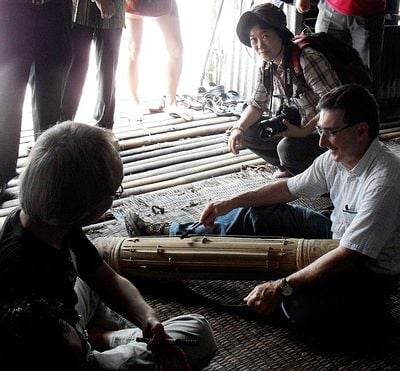
The 'teacher' (an older man who is training many of the younger men in how to play) said they had a legend about 300 years old concerning a hunter in the jungle who was bored while waiting to trap wild boars and to while away the time he began to play with a length of bamboo, first as a drum then with modifications until it became the instrument they use today. Fascinating.
Other longhouses, much deeper in the rainforests, and more remote, have less modern accoutrements, some without electricity, so you have an interesting perception of what is and is not ‘authentic’. The people are authentic: i.e. they are B/idayuh or land Dayaks; their dances and music are traditional even if they wear modern cotton and nylon costumes albeit decorated with traditional patterns and cut in traditional styles; and houses and split bamboo walkways are traditional in form and shape, thus authentic: but some of the constructions are no longer made of ‘bush’ materials since roofs are often corrugated iron and in many places the 'liana' (jungle vine used to lash together the hundreds, perhaps thousands of split bamboo lengths that make up the floor, verandah and walkway of a longhouse) has been replaced with plastic string or rubber strips. Bamboo rafts and dugout canoes are authentic: but some canoes now have a small outboard motor attached! So, what sort of experience do you have? Well, I would suggest it is a Borneo experience that you can have only in this part of the world and while some aspects and elements may not be traditional, I would argue that they are authentic!
|


 E
E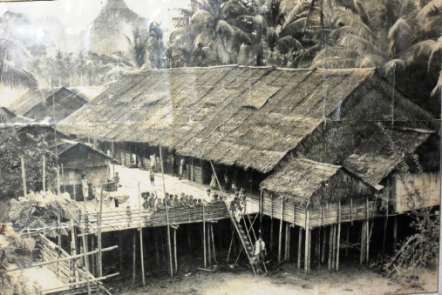 We
are currently in Kuching, Sarawak, in the context of the "Five Year
Community based Ecotourism Strategy for the Brunei - Indonesia - Malaysia -
Philippines East Asia Growth Area." The project is supported by the five
Governments who requested the Asian Development Bank to assist in
formulating the Strategy and each government has proposed a number of
possible pilot sites which we are assessing now. In particular, w
We
are currently in Kuching, Sarawak, in the context of the "Five Year
Community based Ecotourism Strategy for the Brunei - Indonesia - Malaysia -
Philippines East Asia Growth Area." The project is supported by the five
Governments who requested the Asian Development Bank to assist in
formulating the Strategy and each government has proposed a number of
possible pilot sites which we are assessing now. In particular, w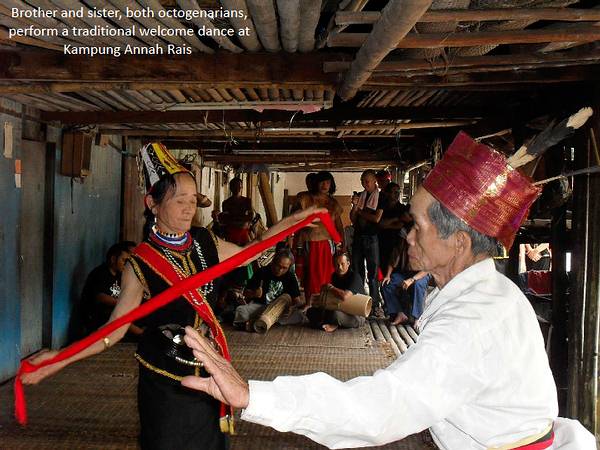 At
AnnahRais kampung we had an extraordinary welcome dance performed for us by
two octogenarians, a brother and sister. Very old, very graceful, very
deliberate, just poetry in slow motion. They were backed by five men playing
traditional instruments - a drum that has become a string instrument! Check
out the photos - each length of giant bamboo has had slivers cut from the
surface of the bamboo and raised and then tensioned with little 'stops'
underneath them, so that the outside of each drum now has five to seven
'strings'. The 'stops' create perhaps two or three different notes for each
'string' because of the differential tension on the strings (replacing the
finger that presses down on a guitar string to create different notes along
the same string). These drums are played with a combination of taps on the
strings with a small rounded drum stick, a flat hand-palm slap on the
underside of the drum (bongo-type drum beat) and then down one side they
have another string which is used exclusively for strumming in exactly the
same way as a guitar string. So, one hand uses the tap stick for the main
melody, and the other slaps the drum and strums the special string for the
beat. Their melodies use all three techniques to produce very distinct
harmonies. Only nine kampungs in a remote area of Sarawak have this
instrument.
At
AnnahRais kampung we had an extraordinary welcome dance performed for us by
two octogenarians, a brother and sister. Very old, very graceful, very
deliberate, just poetry in slow motion. They were backed by five men playing
traditional instruments - a drum that has become a string instrument! Check
out the photos - each length of giant bamboo has had slivers cut from the
surface of the bamboo and raised and then tensioned with little 'stops'
underneath them, so that the outside of each drum now has five to seven
'strings'. The 'stops' create perhaps two or three different notes for each
'string' because of the differential tension on the strings (replacing the
finger that presses down on a guitar string to create different notes along
the same string). These drums are played with a combination of taps on the
strings with a small rounded drum stick, a flat hand-palm slap on the
underside of the drum (bongo-type drum beat) and then down one side they
have another string which is used exclusively for strumming in exactly the
same way as a guitar string. So, one hand uses the tap stick for the main
melody, and the other slaps the drum and strums the special string for the
beat. Their melodies use all three techniques to produce very distinct
harmonies. Only nine kampungs in a remote area of Sarawak have this
instrument.